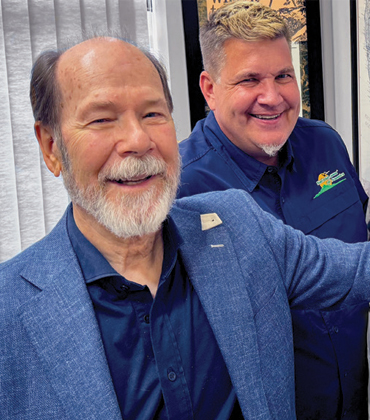
 Philip Catron, Founder and President and Blaine Young VP of Franchise
 Every breakthrough begins with resistance.
A lesson
NaturaLawn of America’s Founder and President Philip Catron embraced early in his career. In the late 1970s, while working in the lawn care industry, he proposed a safer, organic-based alternative to chemical-heavy practices, and met rejection at every turn.
At the time, the industry depended entirely on pesticides and synthetic fertilizers. The mindset was to use more chemicals to achieve greener lawns. But the results came at a cost. Pets were being poisoned, lawn care workers consistently fell ill and homeowners were told to stay off their grass after treatments.
When the companies he worked for dismissed his calls for an organic-based alternative, he launched NaturaLawn of America, built on the belief that lawns could be both healthy and safe. Using a franchise model to expand its reach, the company has since grown into the nation’s leading organic-based lawn care provider and the third-largest lawn care company in the country.
Catron adopted the idea of building soil health rather than masking problems with chemicals. He developed fertilizers enriched with more than 80 species of beneficial microbes and combined them with biological controls for weeds, insects and diseases. These microbes improved the soil itself, breaking down organic matter into nutrients, outcompeting harmful pathogens and activating the turf’s natural defenses, so lawns could thrive without the need for synthetic treatments at all.
The impact is seen in customer experience. Across the industry, about half of clients typically call back with complaints or service requests after an application. At NaturaLawn, that number is less than three percent. Renewal rates tell the same story, averaging above 85 percent.
-
Instead of treating the lawn like a restricted area, families could freely enjoy their outdoor space. With us, they get a healthy, green lawn without worrying about children or pets being exposed to harmful chemicals.
Such results are possible because NaturaLawn rejects the industry’s one-size-fits-all chemical programs and builds its service model around customization. Each relationship begins with a soil test that examines composition, pH balance, nutrient levels, drainage and sunlight. From there, a tailored plan is created, applying the right mix of microbes and treatments to match the lawn’s specific needs.
“Instead of treating the lawn like a restricted area, families could freely enjoy their outdoor space. With us, they get a healthy, green lawn without worrying about children or pets being exposed to harmful chemicals,” says Catron.
Merging the local presence of franchisees with the national support of NaturaLawn, the company has built a model that balance independence with scale. For a $39,500 investment, franchisees gain access to exclusive fertilizers and lawn care programs, as well as branded services like Mosquito Ranger (all-natural mosquito control) and Tick Ranger (all-natural tick control). These add-on services create additional revenue opportunities while giving customers safer options to protect their families and pets. Makes Naturalawn an incredible opportunity Young says.
Franchise owners also receive structured training, operational support and ready-to-use marketing campaigns, resources that help them establish and grow their businesses effectively in local markets. With operations in 27 states and the District of Columbia, more than 128,000 customers and projected revenues of $115 million in 2025, the balance of local execution and national backing has produced measurable results. NaturaLawn’s continued family ownership reinforces that growth, reassuring franchisees that the company will stay independent and consistent with the values it was founded on.
“It’s a win-win for everyone. Franchising allows us to expand efficiently, such as our current focus on the South and Midwest, without the cost of building corporate-owned branches. Franchisees gain a proven business model with exclusive products and support, while customers receive safe, reliable lawn care tailored to their needs.”
Innovation adds to that strength. A promising project underway is the conversion of food waste into sustainable fertilizer, expected to be commercially available within two years.
Changing the course of the lawn care industry from heavy reliance on chemicals to an organic, soil-first approach, NaturaLawn has proved that performance and safety can go hand in hand. The result is more than just greener grass. It is healthier lawns, safer outdoor spaces and stronger communities built on trust.
Choosing Organic-Based Lawn Care with Discipline
A lawn can look acceptable for one season while repeated blanket treatments leave the soil dependent on constant correction. For executives managing campuses and other properties, appearance is only part of the equation. The bigger question is whether a provider can maintain healthy turf without applying more material than necessary or creating unnecessary exposure for occupants. Repeated corrective treatments can also push long-term service costs beyond what was initially proposed.
The phrase “organic-based” also deserves a closer look. It should reflect the approach behind a treatment, not simply serve as a broad environmental label. Organic inputs may work in some situations, but severe weed or pest pressure may require targeted control. Providers should explain that distinction before work begins, including when a traditional input may be necessary. The response should remain proportionate to the problem. Claims of being natural or green offer little assurance if application decisions stay the same.
Soil testing can help distinguish a tailored lawn care program from routine product application. Without it, a fertilizer schedule may promote visible growth while overlooking problems such as imbalanced pH or weak root development. A better approach starts with understanding the soil and tailoring the program to its condition. Buyers should also find out whether those results actually influence what materials are used and when they are applied, rather than simply being included in a standard report.
Treatment discipline matters just as much. Blanket spraying may be convenient for the provider, but it makes little sense when a problem is limited to one small area. Spot treatments and nonchemical options can reduce unnecessary applications, provided technicians know when to use them. This makes proper training important. Field staff should be able to identify whether the issue is actual pest pressure or the result of site conditions, such as poor grading or limited sunlight, and address what is causing the problem.
Product composition matters too. A lower-impact label does not mean much if the fertilizer contains material the turf cannot use or needs to be applied often to keep up a temporary appearance. Procurement teams should ask how much of each formulation is actually available to the plant and whether each soil input has a clear purpose. They should also ask whether the program helps reduce waste over time. Pricing should be weighed against how often applications are needed and how much corrective work may follow, not just the quoted visit rate.
“NaturaLawn of America’s approach starts with soil testing and uses proprietary fertilizers made with natural minerals and beneficial soil inputs.”
Expectations need to be clear from the beginning. A lawn changes with the weather and how the property is used, so promising it will always look the same can create problems later. Providers should agree on what the buyer considers acceptable and explain how the lawn may change through the seasons. Any changes to the property should be noted before more treatment is recommended. Honest advice can help avoid unnecessary applications and disagreements about the results.
NaturaLawn of America is a strong choice for buyers looking for an organic-based program focused on measured intervention instead of routine chemical use. The approach starts with soil testing and uses proprietary fertilizers made with natural minerals and beneficial soil inputs. Integrated pest management relies on trained technicians, with controls chosen for each situation. Biological and biorational options are used when appropriate. This gives buyers a practical way to maintain healthier turf while addressing serious pest problems, without making unrealistic claims about what organic lawn care can deliver.
...Read more